Custom golf umbrellas
Large-arc umbrellas on wind-resistant fiberglass frames. Eight wide panels make this the format that carries a brand best, which is why logo printing is treated as standard specification here rather than a paid upgrade.
Standard configurations
Arc size is measured across the canopy when open. The 68" is the most widely ordered of the three and usually carries the best balance of price and presence.
| Item | Standard range | Notes |
|---|---|---|
| Arc size | 60" / 68" / 72" | 68" is the most common volume size |
| Panels | 8 panels | Single colour or alternating panel colours |
| Canopy fabric | Pongee 190T, polyester; RPET option | RPET supports recycled-content claims — ask for documentation |
| Frame | Fiberglass ribs, wind-resistant construction | Double-rib or reinforced frames available for exposed use |
| Shaft | Steel, aluminium, fiberglass or wooden | Shaft material affects both weight and price |
| Handle | Straight, crook, EVA, wooden, rubberised | Handle is the most frequently customised part after the canopy |
| Opening | Manual open, auto open | Auto open adds cost and a failure point — specify if it matters |
| Tips & ferrule | Standard or custom moulded | Logo moulding on tips requires tooling |
| Printing | Screen print, heat transfer, digital print | One logo per panel, or a repeating pattern across all eight |
| MOQ | 300–500 pcs per colour | Higher for custom handles or dyed-to-order fabric |
| Lead time | 25–35 days after sample approval | Longer in Q4 gifting season |
Typical values for standard models. Your quotation and pro forma invoice define the order.
What "wind-resistant" actually means
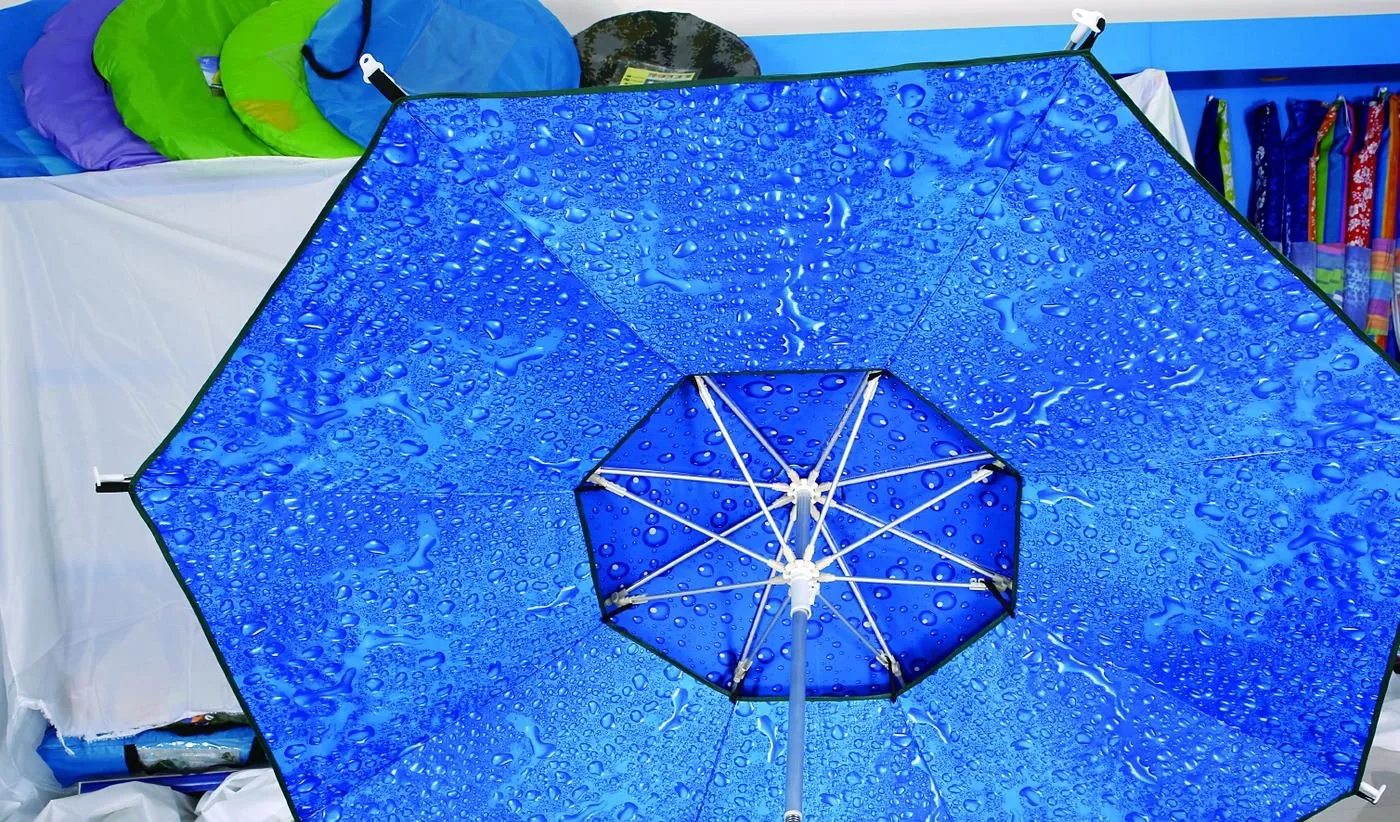
A golf umbrella fails at the ribs or at the joint, not at the fabric. Fiberglass ribs flex and return; steel ribs bend and stay bent. That single difference drives most of the price gap between a promotional-grade and a golf-grade frame.
- Rib material — fiberglass for flex, steel for cost, aluminium for weight
- Rib count and profile — 8 ribs is standard; reinforced profiles resist inversion
- Joint construction — stress concentrates where ribs meet the shaft
- Venting — a vented canopy sheds wind instead of catching it
"Wind-resistant" is marketing language until it is written as a material and a construction. Tell us the material, rib count and whether venting is required, and the quote will be comparable across factories.
Turning the claim into a test
Each of the four factors above has a published test condition behind it. Writing the number into your specification is what lets you reject a shipment rather than argue about it.
| Factor | Tested as | Reference criterion |
|---|---|---|
| Wind resistance | Held in a 10 m/s wind for 30 seconds | No deformation, bending or damage affecting use. Ribs may invert — inversion is not failure |
| Frame durability | Continuous open and close cycling | Commonly 600 cycles for manual straight umbrellas, 400 for automatic |
| Opening force | Force measured at the push button | 10 N to 55 N for adult umbrellas; self-opening compression not above 100 N |
| Corrosion | Neutral salt spray — shaft 4 hours, other parts 2 hours | Grade 4 or better |
| Safety | Rib tip coverage and component retention | Mandatory national safety standard for umbrella products |
Criteria as published in the current national product standard. Some regional specifications use a higher wind speed and a higher UPF threshold. See Standards & compliance.
Eight panels, one message
The panel layout is what makes this category work for brands. Decide early whether your logo repeats on every panel or appears on one or two, because it changes the print method and the cost.
Screen print
Best for solid-colour marks up to a few colours. Lowest unit cost at volume and the most durable on pongee.
Heat transfer
Handles gradients and photographic artwork that screen printing cannot reproduce cleanly.
Digital print
Full-panel coverage and patterns across all eight panels. Highest cost, strongest shelf impact.

One colour per panel — the simplest repeat layout

Alternating panels — contrast makes the logo read from further away
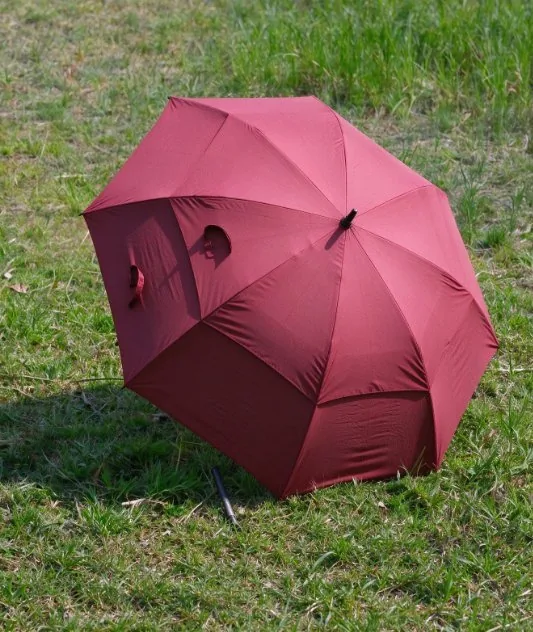
Solid ground colour — the safest base for a single-position mark
The parts buyers upgrade first
When a golf umbrella programme moves upmarket, the handle and the sleeve are usually what change before the canopy does.
Handle options
Straight EVA, crook, wooden, rubberised or leather-look. Custom tooling on a handle is possible and is quoted separately.
Matching sleeve
Printed or woven sleeve that carries the same artwork as the canopy; useful for retail presentation.
Custom tips and ferrule
Moulded parts with a logo or a specific shape. Tooling cost applies and lead time extends.
Wrist strap and closure
Strap material, closure type and any printed detail on the tie are confirmed at sampling.
Packing and shipping
| Item | Typical | Notes |
|---|---|---|
| Inner packing | 1 pc per polybag or sleeve | Retail packaging quoted as an option |
| Outer carton | Confirmed per model and length | Long straight umbrellas drive carton length and container fit |
| Loading port | Ningbo | About 1.5 hours by road from the cluster |
| Incoterms | FOB Ningbo, EXW, CIF on request | State your preference in the enquiry |
| HS code | 6601 | Confirm the sub-code with your broker |
Reference golf configurations
Six golf builds from the same cluster. Panel count, frame material and handle type are the three decisions that move unit cost the most.
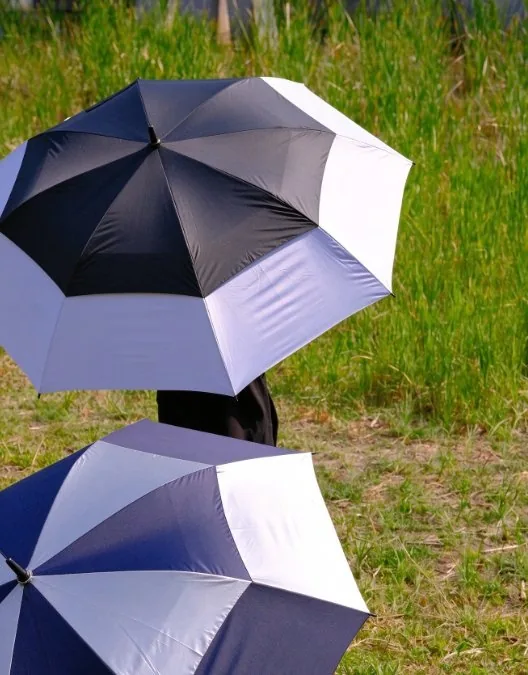
Two-tone panels — the base case for most printed golf orders
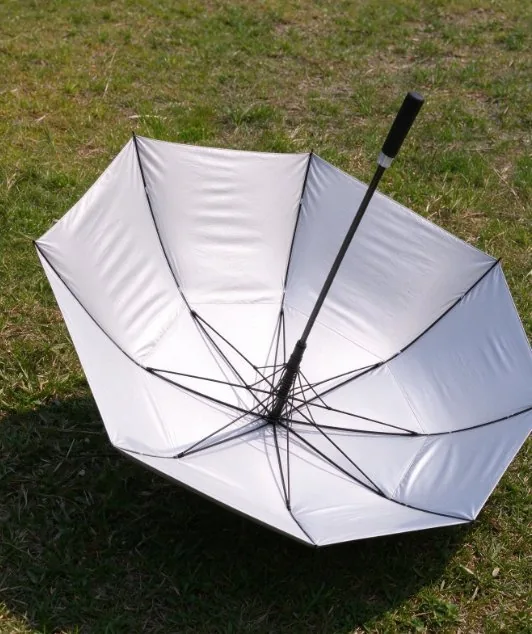
Rib layout seen from below — eight ribs is the golf default

Solid colour canopy — the simplest panel option at any quantity

Top view — panel seams are where a logo is normally aligned
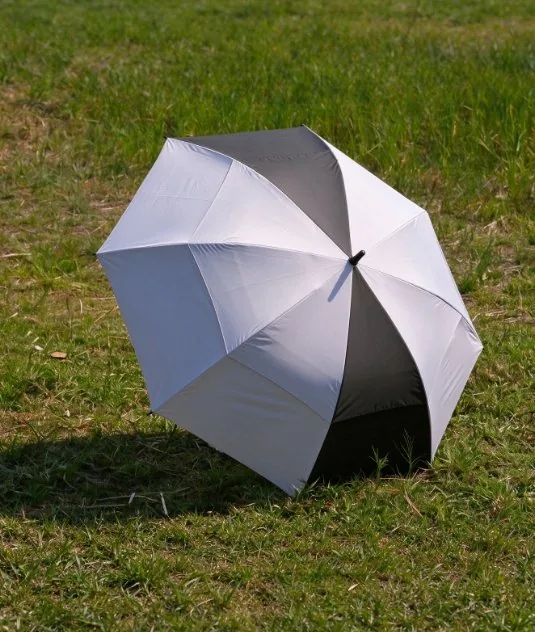
Multi-panel colourway — each extra colour usually means one extra screen

Panel seam and binding — specify both if your artwork crosses a seam
Golf umbrella questions
Which arc size should I choose?
68" suits most corporate and promotional programmes; 72" is chosen where presence matters more than portability, and 60" where the umbrella needs to be easier to carry. Tell us the end use and we will advise.
Can each panel be a different colour?
Yes, alternating panel colours are standard. More than two colours per canopy usually pushes MOQ up because it affects how fabric is cut and sewn.
Do you offer recycled fabric?
RPET options exist in this category. If you need to make a recycled-content claim, ask for the supporting documentation at quotation stage so we can source from a factory that holds it.
What artwork format do you need?
Vector files are preferred — AI, EPS or PDF. Send Pantone references with them. High-resolution raster files can be used for digital print but not for clean screen output.
Get a golf umbrella quote
Send arc size, quantity, artwork and destination. We reply with factory options, print method recommendation and a sample plan.
What actually moves the unit price
Materials are typically 60–80% of the cost of a custom umbrella, so specification — not negotiation — decides most of your landed price. These are the levers you control, and we itemise every one of them in your quotation so you can compare suppliers line by line.
| Cost driver | Leaner choice | Premium choice | Typical effect |
|---|---|---|---|
| Canopy fabric | 190T polyester | Oxford, or solution-dyed acrylic for outdoor programmes | Fabric cost +30–80% |
| Frame & ribs | Aluminium, 8 ribs | Fibreglass for wind resistance, stainless steel for premium builds | Frame cost +25–100% |
| Shaft | Steel | Aluminium or reinforced, with finish grade | +20–40% |
| Handle | Injection-moulded plastic | Soft-touch, wood, or a custom mould | 2–4× |
| Printing | Single-colour screen print | Full-colour sublimation or all-over print | Several × |
| Order quantity | 1,000+ units | 300 units | Tooling and set-up spread over fewer pieces |
| Packing | Bulk cartons | Individual sleeve, printed box, retail-ready pack | Added material and labour |
Ranges reflect published umbrella-industry cost breakdowns and are indicative, not a quotation. Buyers with a fixed budget usually get the best result by spending on ribs and fabric first, and simplifying printing and packing.
Hold it before you commit
A pre-production sample is the cheapest way to de-risk a custom programme. You see the fabric, the frame, the print and the finish in your own hand — and you approve the exact build that then goes into bulk.
7–10 days
Standard pre-production sample once artwork is confirmed. A new frame development or custom-dyed fabric takes 14 days or more, and we tell you which applies before you pay.
Fee credited back
The sample charge is deducted from your first bulk order. For a programme that goes ahead, sampling effectively costs you nothing.
What we need to start
A drawing, a reference photo or a target specification. Artwork can follow — vector is preferred, but we work from whatever you already have.