
How a custom umbrella order actually runs
Most first-time buyers are not worried about price — they are worried about what happens after they pay. This page lays out the whole path: what we need from you at each stage, what we do, how long each step takes, and where orders usually go wrong.
The eight stages — and who does what
A custom umbrella order is not one decision, it is eight. Each stage has an owner, an input and an output. When buyers know the sequence, the process feels predictable instead of opaque.
| Stage | What we need from you | What we do | Typical duration |
|---|---|---|---|
| 1. Enquiry | Category, target quantity, destination port, artwork if any | Confirm feasibility, flag constraints, propose factory options | Same or next business day |
| 2. Quotation | Answers to our follow-up questions | Itemised quote: unit price, MOQ, tooling, sampling, packing, lead time | 1–3 business days |
| 3. Sample | Sample payment, shipping account or courier address | Build to spec, ship sample with a photo report | 7–10 days production + transit; 10–14 where new tooling or custom-dyed fabric is involved |
| 4. Approval | Written approval of the sample or a change list | Lock the specification as the reference standard for bulk | Your timing |
| 5. Production | Deposit payment, confirmed PO | Purchase materials, produce, run in-line checks | 25–35 days from approved sample; 40+ if booked into peak season |
| 6. Inspection | Nothing — or your own inspector | Final inspection against the approved sample, AQL sampling | 1–2 days |
| 7. Shipment | Balance payment before release of documents | Book freight, customs clearance, send documents | 3–7 days port-to-sailing |
| 8. Reorder | Same PO reference, adjusted quantity | Re-run from the locked spec — usually faster than the first order | Shorter than stage 5 |
Durations are typical for orders placed outside the October–December peak. Peak-season and first-time tooling orders run longer — we say so at quotation, not after the deposit.
What the calendar looks like for a first order
Two clocks run at once: our production clock and your delivery clock. Here is how they fit together for a typical first custom order.
| Week | Milestone | Notes |
|---|---|---|
| Week 1 | Enquiry answered, quote issued | Faster if your artwork and target quantity are already decided |
| Week 1–2 | Sample payment received | Sample cost is credited against the bulk order in most cases |
| Week 3–4 | Sample shipped | DHL or FedEx, 3–6 days transit to most destinations |
| Week 4–5 | Sample approved in writing | This document becomes the reference standard for bulk |
| Week 5 | Deposit received, production starts | 30% deposit is standard for new accounts |
| Week 6–10 | Production and in-line checks | Weekly progress updates with photos on request |
| Week 10–11 | Inspection, balance payment, documents released | Inspection photos sent before you pay the balance |
| Week 11–16 | Sea freight to destination | Ningbo to North Europe ~30–35 days; US West Coast ~14–18 days |
Buyers who need goods for a fixed event — a trade show, a tournament, a product launch — work backwards from the event date, not forwards from the quote date. If your goods must be on site by a certain day, tell us that day at enquiry stage. Freight and peak-season queues, not production, are what usually break the plan.
How sampling works — and what it costs
Sample payment
Custom samples are charged, not free, because they consume fabric, printing plates and machine time that cannot be resold. The sample charge is usually credited back against the bulk order when the order proceeds. Stock samples from existing models can be free or at cost plus courier.
What a sample proves — and what it does not
- Colour against your Pantone or physical reference
- Print placement, size and registration on the real fabric
- Construction: rib count, stitching, hardware, open-close action
- Whether your artwork is legible at the size you chose
A sample does not prove batch colour stability, wash durability or production speed. Those are handled by the locked specification, in-line checks and final inspection.
Two ways to approve
Physical pre-production sample
The default for orders above roughly 500 units and for any new model. You hold the exact item your bulk run will be compared against.
Photo or video approval
For smaller orders or tight deadlines. Detailed photos plus a short video of the mechanism cycling. Faster and cheaper, but it commits you earlier — we tell you honestly which situations suit it.
Ask us to keep one approved sample in our office alongside yours. When a dispute or a reorder comes up months later, the physical reference settles it in minutes instead of weeks of email.
What adds time or cost — before you ask
Custom work is not expensive by default. These four things are. Knowing them at enquiry stage keeps your first quote close to your final invoice.
| Variable | Why it matters | What we do about it |
|---|---|---|
| Custom-dyed fabric colour | Dye lots have minimums far higher than umbrella MOQs; a 300-piece order in a special colour may carry the dye-lot minimum in the price | Offer closest standard colours, or propose a two-tone design where only panels are custom |
| Custom tooling | A new handle mould, tip shape or base die is a real factory investment, amortised over your order quantity | Quote tooling separately and transparently; tell you when stock tooling is close enough |
| Printing screens or plates | Each colour position is a screen; complex multi-colour artwork multiplies setup | Recommend reducing colours where the design allows — often the largest single saving |
| Special packaging | Retail boxes, individual polybags, hangtags, barcode labels and carton markings each add a process | Send the packaging spec at enquiry, not after production starts |
Working with promotional distributors
A large share of custom umbrella business in this cluster runs through promotional products distributors, and the trade has its own conventions. Here is what the distributor side of the industry expects — including the parts that are not flattering.
What the trade expects
- Distributor-only pricing — suppliers serve the trade, not the end client directly. We keep that boundary.
- ASI / SAGE / PPAI numbers — distributors quote these when they approach suppliers. Tell us yours and it speeds up vetting on both sides.
- Blind shipping — your name on the paperwork, not ours. Standard, and we do it without being asked.
- Full-panel artwork flexibility — promotional buyers mix fabric colour, handle style and print on one base model.
The honest numbers
Overseas custom umbrella programmes commonly run 500 pieces and up per design — 300 is workable at a premium on stock canopy colours, and above 1,000 you reach the quantities where unit economics genuinely improve. Realistic cycles run up to 120 days from final approval once custom colours, artwork approval, sampling, production and sea freight are counted. Suppliers who promise dramatically faster on fully custom work are either quoting stock with a logo added, or planning to disappoint you.
The October–December window is the busiest of the year for this trade. An order approved in November may not sail before January. If your client's event is in spring, the practical decision point is late summer, not January.
Some artwork cannot be printed as supplied — too many colours for the fabric, line weights too fine for screen, gradients that dye-sublimation will shift. Send it early. Catching it before you quote your client protects your margin, not ours.
How money moves on a first order
| Stage | Standard structure | Why |
|---|---|---|
| Sample | 100% in advance | Sample cost is small and credited against the bulk order |
| Bulk order — deposit | 30% T/T before production | Covers fabric purchase and factory scheduling |
| Bulk order — balance | 70% against copy of B/L, or before release of originals | You see inspection photos and documents before the goods leave |
| Later orders | Negotiable — often 30/70, sometimes better | Payment history is the cheapest trust either of us can build |
L/C at sight is accepted where the order size justifies the bank cost. Terms beyond these — open account, net-30, net-60 — are possible after a track record, not before one.
No deposit, no production. Fabric bought on credit and machine time booked for a buyer who disappears is how factories stop working with new trading partners — and that costs you access, not just us money.
Why the second order is the one that matters
In this trade the first order is a qualification exercise. The economics live in reorders — for both sides.
What gets faster
- Specification is locked — no new sampling unless something changed
- Printing screens are usually retained for a period, removing setup time
- Factory scheduling is based on a known quantity and pattern
- Inspection criteria already written and agreed
What gets cheaper
- No sampling or tooling spend
- Better fabric pricing at repeat volumes
- Freight often consolidated across programmes
What we ask of repeat buyers
Keep artwork files, Pantone references and the approved sample reference number with your own PO. A reorder that arrives as "same as last time, but the 68-inch" takes days to clarify; one that arrives with the reference takes hours.
If you buy seasonally, tell us the month. Fabric slots and factory lines get booked early in this cluster, and a buyer with a predictable rhythm gets a predictable price.
Staging and approval
Production photos are taken and approved at the staging stage, before cartons are sealed. Ask for them at this point, not after loading.
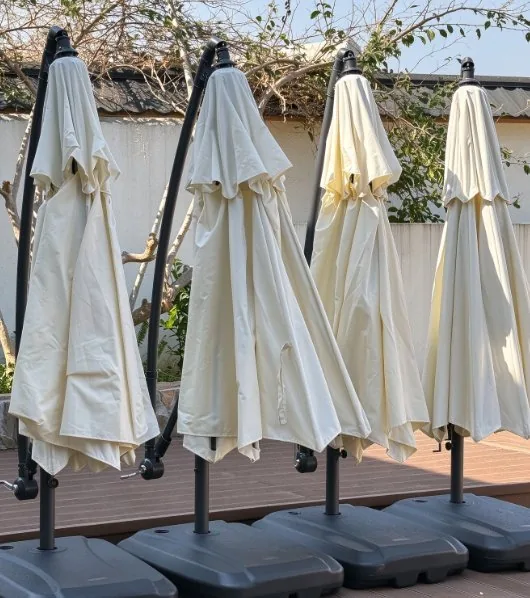
Finished goods staged before packing — the point where you approve photos
Ready to start at stage one?
Send your category, quantity and destination. You will get a feasible answer — including a polite no if your requirement does not fit this cluster.
Ask about this
Tell us the specification, quantity and delivery window. We come back with factory options, MOQ, a sampling plan and an itemised quote — normally within one business day.
Hold it before you commit
A pre-production sample is the cheapest way to de-risk a custom programme. You see the fabric, the frame, the print and the finish in your own hand — and you approve the exact build that then goes into bulk.
7–10 days
Standard pre-production sample once artwork is confirmed. A new frame development or custom-dyed fabric takes 14 days or more, and we tell you which applies before you pay.
Fee credited back
The sample charge is deducted from your first bulk order. For a programme that goes ahead, sampling effectively costs you nothing.
What we need to start
A drawing, a reference photo or a target specification. Artwork can follow — vector is preferred, but we work from whatever you already have.