Recycled content and PFAS-free finishes — what is real and what is paperwork
Since 2026, two questions arrive in almost every EU and US enquiry: is the recycled claim documented? and is the finish fluorine-free? Both have hard regulatory dates behind them. This page explains what each actually means, what it costs, and what evidence you should demand from any supplier — including us.
The regulatory timeline that changed the conversation
Sustainability claims moved from marketing to compliance between 2025 and 2026. These are the dates that matter for textile and outdoor products.
| Date | Jurisdiction | What changed |
|---|---|---|
| Jan 2025 | California & New York, USA | Intentionally added PFAS banned in most textiles; disclosure labels for severe-wet-weather outerwear |
| Jan 2026 | France | First national PFAS ban covering manufacture, import and sale of PFAS-containing clothing, textiles and footwear |
| Jan 2026 | Maine, USA | Sales prohibition on most textile articles containing intentionally added PFAS |
| 10 Oct 2026 | EU — REACH Annex XVII | PFHxA restriction in force: 25 ppb PFHxA, 1,000 ppb PFHxA-related substances in consumer clothing. C6 fluorinated DWR falls inside the limit |
| Jul 2026 | Denmark | Import and sales ban on PFAS-containing clothing, footwear and certain water repellents |
| In progress | EU — universal PFAS restriction | ECHA RAC opinion adopted March 2026 backing a full ban with a PPE exception; SEAC opinion expected end of 2026, Commission decision after |
| Jan 2027 | California, USA | Organic fluorine threshold tightens from 100 ppm to 50 ppm, covering unintentional PFAS presence |
Summarised from public regulatory sources for orientation only. Regulations carry derogations, scope definitions and transitional periods — your compliance team or test lab remains the authority for your product category.
What "PFAS-free" actually requires
Fluorinated DWR finishes dominated water repellency for a decade. They are now regulated out of consumer textiles in the EU, and the replacement chemistry has a real trade-off buyers should understand.
The chemistry shift
- C8 chemistry left the market in the 2010s over PFOA; the industry moved to shorter C6 chains
- The October 2026 EU restriction catches C6 as well — so the move is to fluorine-free: paraffin, silicone and hydrocarbon-polymer DWR
- On water alone, fluorine-free repellency performs. The honest trade-off is elsewhere
The trade-off, stated plainly
- Fluorine-free DWR is not oleophobic — it sheds rain but not oil, grease or sunscreen
- A soiled surface wets out sooner; fluorine-free items need washing and heat reactivation more often
- For a shade canopy this rarely matters operationally — but for a client selling a performance claim, it matters contractually
What documentation looks like
- A declaration from the finishing supplier that no fluorinated DWR was applied
- Third-party test reports where the buyer's market requires them — testing methods such as ISO 18853 are referenced for PFAS-free verification
- A materials statement covering the whole article, not just the face fabric — linings, seams tapes and trims included
Not every factory in the cluster has completed the fluorine-free transition. For EU-bound programmes we confirm the finishing route at quotation stage and put it in writing on the specification sheet — so the compliance question is settled before production, not at customs.
What this means for umbrellas and tents
Umbrella canopies are usually PU or acrylic coated rather than fluorocarbon finished — but that is not the whole article, and assumptions are exactly what gets shipments stopped.
| Component | Where fluorinated chemistry can hide | What to confirm |
|---|---|---|
| Canopy water-repellent finish | Some premium or "easy-clean" finishes use fluorinated repellents | Whether the specified finish is fluorine-free, in writing |
| Stain-resistant or easy-clean coatings | Marketed as functional finishes; often fluorinated | Whether your product really needs them at all — most do not |
| Tent and shelter fabrics | Higher-spec PU coatings and seam treatments vary by supplier | Full materials statement per component |
| Trims — thread, bindings, zips | Rarely fluorinated but occasionally coated | Included in the article-level declaration |
Some buyers assume avoiding premium finishes removes the PFAS question. The restriction applies to what was actually applied, not to the price. The only safe position is a written statement of the finishing chemistry for your specific order.
rPET canopies and what GRS actually verifies
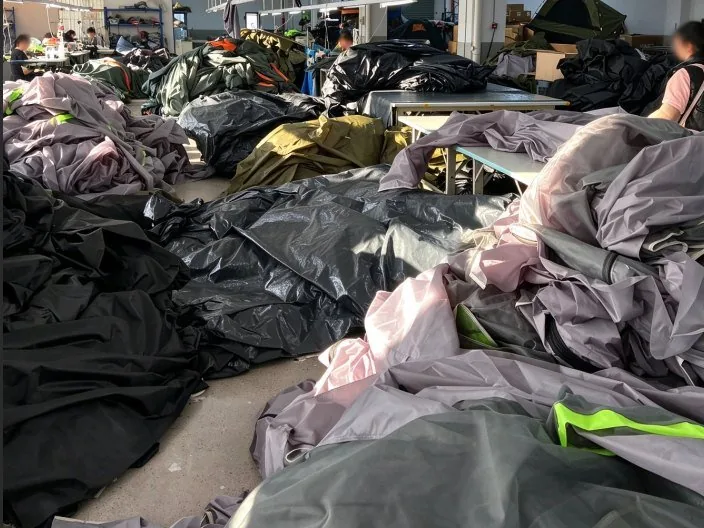
Recycled polyester made from post-consumer bottles performs almost identically to virgin polyester. The difference is not in the fabric — it is in the documentation, and that is where most claims fall apart.
GRS in one paragraph
The Global Recycled Standard is a chain-of-custody certification, not a content label. A fabric needs at least 20% recycled content to carry GRS at all, and 50%+ before the GRS logo may be used in marketing. Every facility between the recycling input and your finished fabric must hold its own valid GRS certificate, with transaction certificates documenting the flow of material between them.
The performance question
- rPET canopy fabric handles print, coating and stitching the same way as virgin polyester
- Expect a modest unit premium over the virgin equivalent at the same specification
- Lead time is comparable once the mill has an established recycled-material supply chain
The five-step verification
- Ask for the scope certificate covering the specific mill — not a group-level or expired one
- Verify the certificate in the certification body's online database, not just the PDF
- Ask for the transaction certificate (TC) tied to your order — the scope certificate proves certification; the TC proves your goods are covered
- Confirm the yarn supplier is also certified — one uncertified link breaks the chain
- Check the certificate scope covers your fabric category, not another one
Public industry reporting identifies the usual failure points: batch records that do not reconcile, recycled and virgin materials not physically segregated in storage, and missing upstream TCs. When a mill cannot produce the chain, the honest answer is "unverified claim" — and we tell you that rather than pass along a number nobody can stand behind.
An unproven claim is now a commercial risk, not just an ethical one
EU regulators increasingly require environmental claims to be backed by verifiable evidence, and retailers are tightening documentation requirements on their suppliers. A recycled-content or eco claim without a certificate and TC is exposure for the brand that prints it.
| Claim on your packaging | Minimum evidence required | Risk without it |
|---|---|---|
| "Made with recycled materials" | GRS (or RCS) scope certificate + order-specific TC | Unsubstantiated claim; retailer rejection; regulatory scrutiny |
| "GRS certified" | GRS specifically — RCS is not equivalent | Mislabelling; the claim is simply false on paper |
| "Eco-friendly" / "green" | Nothing verifiable exists for this phrasing | Highest-risk phrasing of all; avoid entirely |
| "PFAS-free" | Written finishing declaration + test report where required | Non-compliance with EU Annex XVII for consumer textiles |
| "UPF 50+" | Test report to a recognised method (e.g. AS/NZS 4399, AATCC 183) | False performance claim on a safety-adjacent attribute |
What to ask us — and any supplier
Put these in your enquiry
- "Is the canopy available in verified recycled content, and can you supply the scope certificate and TC for my order?"
- "Is the water-repellent finish fluorine-free? Please confirm in writing for this order."
- "Which restricted-substance standards apply to my destination market, and what test reports can you provide?"
- "If I make a recycled or PFAS-free claim, what documentation ships with the goods?"
How we answer
- Directly, in writing, on the specification sheet — including "not verified" where that is the truthful answer
- With the cost impact shown separately, so you can decide whether the documentation premium is worth it for your programme
- With a recommendation on whether the claim is worth making at your quantity and price point
We would rather quote you a verified recycled canopy at a slightly higher price than an undocumented one that your retailer later rejects at the warehouse door.
Building a compliant programme?
Tell us your market and the claims you intend to make. We will tell you what is documentable, at what cost, and before which date you need to decide.