
Umbrella canopy fabric
Fabric is the one component you can buy by the metre, by the roll or as cut panels — and the one where a specification error shows up in every single finished unit. This cluster dyes and prints locally, which is what makes short runs and colour matching practical.
How canopy fabric is specified
Four parameters define a canopy fabric: base weave, yarn count, coating and colour. Add a fifth if you intend to make a performance claim.
| Parameter | Common range | Notes |
|---|---|---|
| Base weave | Pongee, polyester taffeta, Oxford | See fabric types below |
| Yarn count | Commonly 170T–210T grades | Higher count means denser weave and usually a smoother print surface |
| Width | Standard loom widths; slit widths on request | Width drives how many panels you cut per metre |
| Weight | Confirmed per fabric | Stated in grams per square metre on the spec sheet |
| Coating | PU, PA, silver, black, UV resistant | See coatings below |
| Colour | Stock colours, or dyed to Pantone reference | Dyed-to-order raises the minimum |
| Supply form | Roll, cut-to-length, or cut panels | Cut panels save you a process but cost more per unit |
| MOQ | Confirmed per fabric and colour | Stock colours lowest; dyed-to-order highest |
| Lead time | Confirmed per item | Dyeing and printing add time |
Typical ranges for standard production. Send a swatch or specification for an exact quote.
Choosing a base fabric
| Fabric | Character | Best for |
|---|---|---|
| Pongee | Smooth, takes print cleanly, the default for folding and golf umbrellas | Golf, folding and promotional umbrellas |
| Polyester taffeta | Crisp and economical, wide colour availability | Promotional and volume programmes |
| Oxford | Tougher and heavier, takes coating well | Beach shades, shelters and tents |
| RPET polyester | Recycled content with documentation | Programmes with a sustainability requirement |
| Solution-dyed acrylic | Colour held in the fibre, far better fade resistance | Premium patio and resort installations |
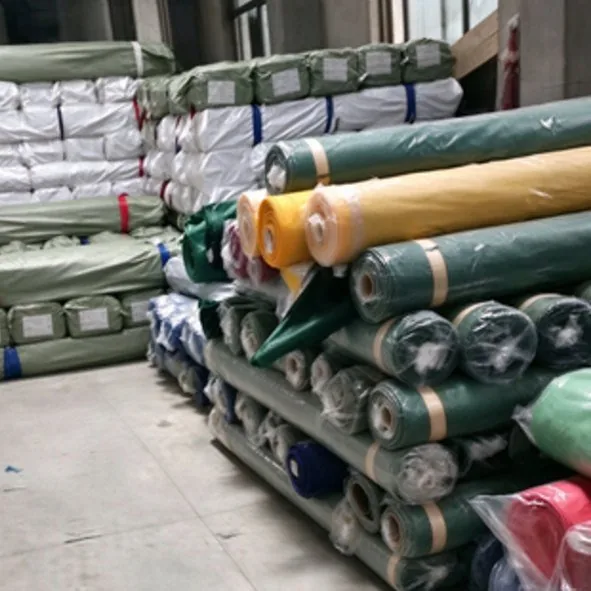
Rolled stock held by shade — buying from stock avoids a dye-lot minimum
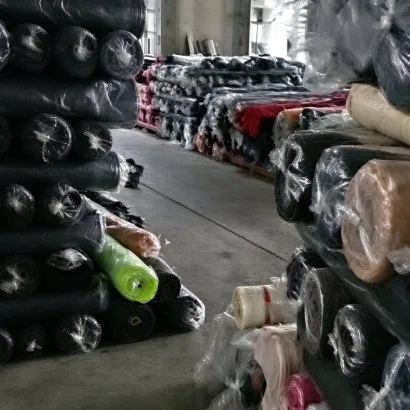
Covered storage — why the same fabric behaves differently from one mill to the next
Where a programme runs below roughly 1,000 units of one colour, the practical choice is usually stock-supported polyester rather than a custom dye lot. We say so at quotation rather than after the deposit.
Getting your colour to repeat
Matching a swatch once is the easy part. The difficult part is the third shipment matching the first — which is why colour is agreed as a reference number and a physically sealed sample, never as a photograph.
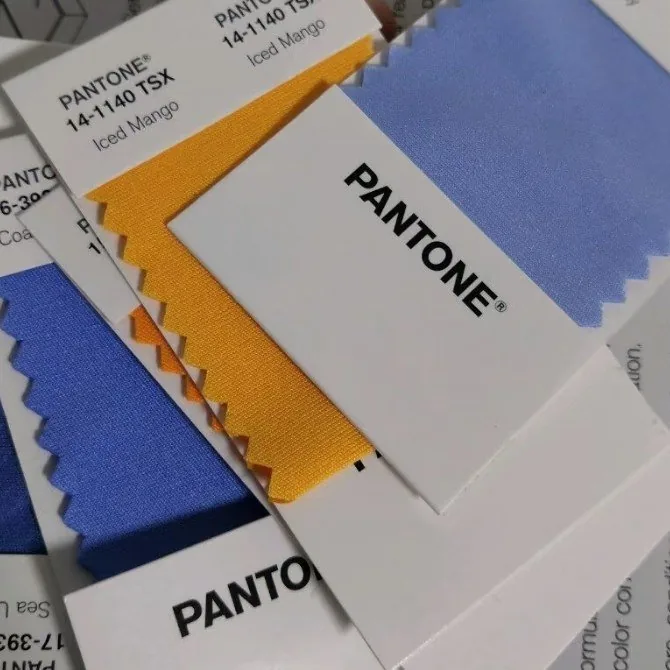
Physical swatches laid against the reference — how a target is agreed
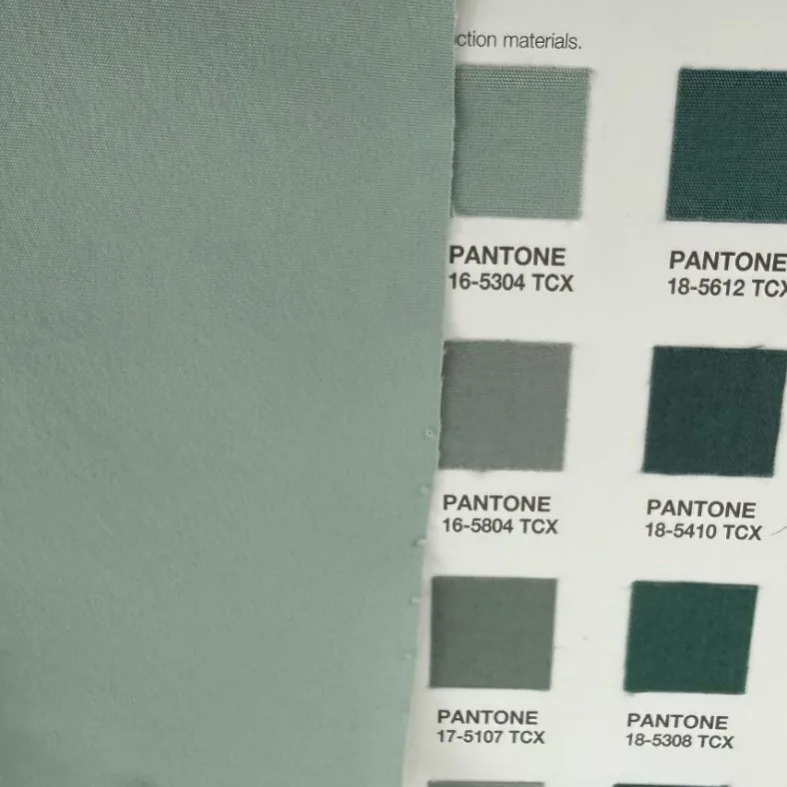
Reading the code on the actual base fabric — the same code shifts by material
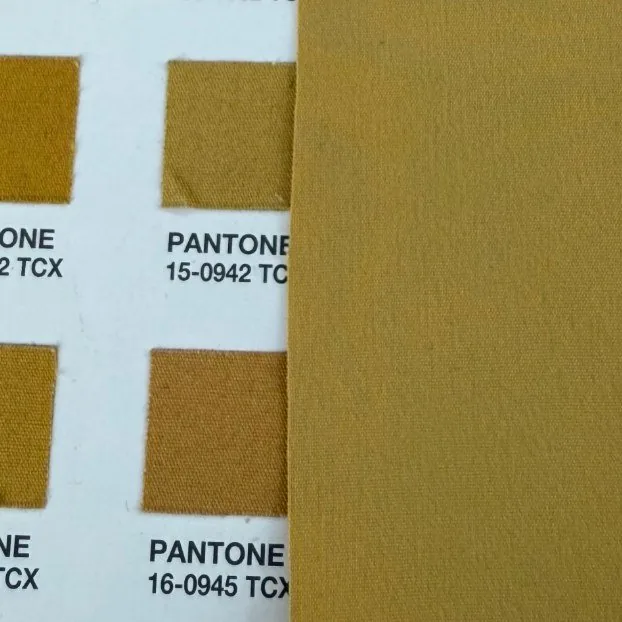
Checked flat and evenly lit — how lab dips are reviewed before they are sent
Send a Pantone TCX reference or a physical swatch. We return lab dips on the base fabric you will actually use, you approve one, and that piece becomes the sealed reference that bulk is checked against. Expect one round of dips as normal, and two where the colour sits close to a fibre boundary.
- A screen is not a colour standard — artwork files shift between monitors and cannot be matched by a dye house. Give us a code or a piece of fabric.
- The base fabric changes the reading — one TCX code dyed on polyester pongee, on Oxford and on solution-dyed acrylic will not look like the same colour. Dips are always made on the production fabric.
- Metamerism is real — a dip that matches under warehouse light can shift under daylight or retail LEDs. We review under more than one source before anything is posted to you.
- Seal one reference — the approved dip is signed and retained. Bulk production is judged against that physical piece, not against a photo sent six weeks earlier.
- Agree the tolerance before bulk — dye lots vary, so the commercial tolerance is written into the order confirmation. That is the point at which it is cheap to discuss.
What the coating does
Most of the performance difference between two umbrella fabrics is in the coating, not in the weave.
PU / PA coating
Standard water resistance, measured as hydrostatic head. General rain umbrella canopies are commonly specified at 3,000 mm and above; storm-grade builds go higher. Specify the number, not the word "waterproof".
Silver coating
Reflects sunlight and reduces heat under the canopy. Common on beach shades and shelters.
Black coating
Blocks light transmission and is the usual route to a high UPF reading. Black-coated canopies generally measure higher than silver-coated or uncoated cloth of the same weave.
UV resistant finish
Slows colour fading. Combined with solution-dyed fibre, this is what makes a patio canopy last more than one season.
UPF rating, hydrostatic head and recycled content are claims that need laboratory evidence. Say so at quotation stage and we will source the fabric and arrange testing together, rather than discovering the requirement after production.
How UPF and waterproof ratings are measured
Two fabrics can both be sold as "UPF 50+" and perform differently after a season, because the number depends on which method produced it. Naming the method is what makes a claim enforceable.
| Method | Region | Conditioning before test | What it means for you |
|---|---|---|---|
| AS/NZS 4399 | Australia / New Zealand | Tested as received, dry and relaxed | Often the highest reading; does not reflect performance after washing |
| AATCC TM 183 | United States | Repeated laundering and light exposure before testing | The conservative benchmark — the rating must survive simulated use |
| EN 13758-1 | Europe | New, dry, unstretched fabric | UPF 40+ is the threshold for a UV-protective label |
| UV Standard 801 | International | Includes stretching, wetting, abrasion and ageing | The most demanding, and closest to real conditions |
UPF 50+ means at least 98% of UV radiation is blocked, allowing no more than 2% transmission. The rating applies to the fabric as tested, not automatically to the finished canopy.
UV protection achieved by weave density and fibre type is permanent. Protection achieved by a chemical coating can fall materially with washing — published figures put the loss at roughly 30 to 50 percent within 15 to 20 industrial wash cycles. If the claim has to survive use, specify the method with pre-conditioning included.
Water resistance is measured as hydrostatic head under ISO 811. Colour fastness uses the ISO 105 series — light fastness for fading, rubbing fastness for printed canopies. Corrosion on metal parts is assessed by salt spray. Each produces a number you can put in a specification.
Printing and fabric compatibility
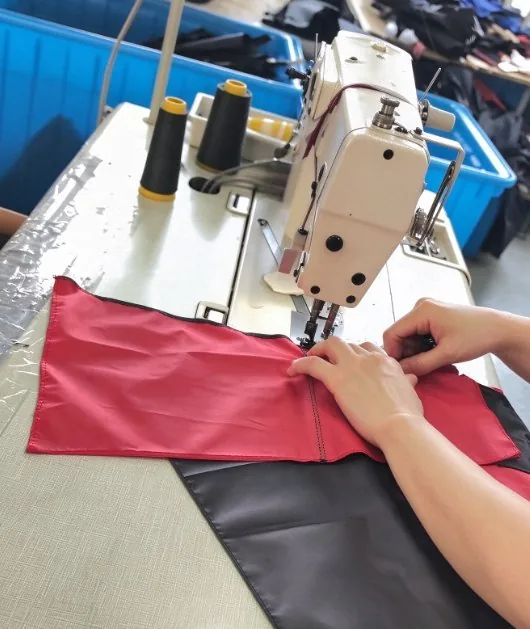
Panels joined on the machine — seam allowance is set by the fabric weight

Panel alignment before joining — where print placement is won or lost
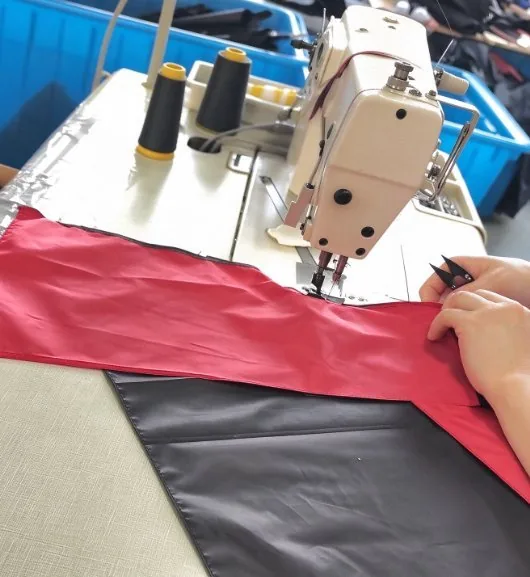
Coated fabric laid flat — coating choice changes how the seam behaves
Not every fabric takes every print method equally. Choosing the fabric before the artwork is finalised avoids the most common rework in this trade.
- Screen print — cleanest on smooth pongee; limited colour count
- Heat transfer — handles gradients and multicolour artwork
- Digital print — full-panel patterns; needs a fabric finished for it
- Rotary / machine print — for all-over patterns at volume
Four things that move the price
1. Base fabric and yarn count
Higher yarn count costs more per metre and usually prints better. Oxford and acrylic sit above standard taffeta.
2. Coating
Each coating layer is a process and a cost. Black coating and UV finishes cost more than a basic PU coat.
3. Colour route
Stock colours are cheapest. Dyed-to-order gives you your colour but raises the minimum quantity noticeably.
4. Supply form
Roll is cheapest per metre; cut-to-length and cut panels add processing but remove a step at your end.
What we check before release
| Check | What it prevents |
|---|---|
| Shade variation between rolls | Panels from different dye lots assembled into one canopy |
| Colour fastness to light and rubbing | Fading and colour transfer in use |
| Coating uniformity | Patchy waterproofing and visible coating marks |
| Hydrostatic head | Canopies that leak under real rain rather than under a spray test |
| Weave defects | Slubs, skipped yarns and holes appearing after cutting |
| Width and length accuracy | Cutting yield falling short of what you planned |
Fabric testing to the standard your market requires can be arranged locally, including through the provincial umbrella parts testing centre based in this district.
Canopy sewing, step by step
Canopy panels are cut, closed and bound before they ever reach a frame. Stitch density and seam construction are what hold a wet canopy in shape.

Panel closing — the seam that decides how the canopy hangs

Seam run — stitch density is a spec worth writing into your order

Binding and topstitch — the finished edge you see on the canopy
Fabric questions
Can I buy fabric without buying umbrellas?
Yes. Fabric is supplied by the roll, cut to length, or as cut panels, independently of any finished goods order.
Can you dye to my Pantone colour?
Yes. Send the reference and, ideally, a swatch. Dyed-to-order carries a higher minimum than stock colours, and we confirm the achievable tolerance before sampling.
Do you supply RPET with documentation?
RPET options are available with supporting documentation. Ask for it at quotation stage so the fabric and the paperwork are ordered together.
Which fabric should I use for outdoor installation?
For fixed installations exposed to sun all day, solution-dyed acrylic holds colour far longer than printed polyester. It costs more per metre and usually lasts several seasons instead of one.
Quote canopy fabric
Send fabric type, yarn count, coating, colour reference and quantity in metres — or a swatch — and we will quote.
Request a component quote