
How to compare umbrella quotations when three quotes look nothing alike
You asked three suppliers for the same 2.7 m patio umbrella and got three prices up to 40% apart. This guide shows where the difference usually hides — the fields that never appear on the quotation unless you ask for them — and how to get quotes you can actually compare.
Why the gap exists
Quotation gaps of 20–40% on the same nominal product are normal in this category, and they are rarely about margin. They come from specification fields that two suppliers fill in differently — or leave out entirely.
A quote for "2.7 m aluminium patio umbrella, printed logo" can describe two products with different fabric weights, different rib sections, different frame coatings and different packing. Both suppliers are quoting honestly. The quotes are simply not comparable.
The fix is not to find the cheapest quote. It is to make every quote describe the same product, then compare prices on equal terms.
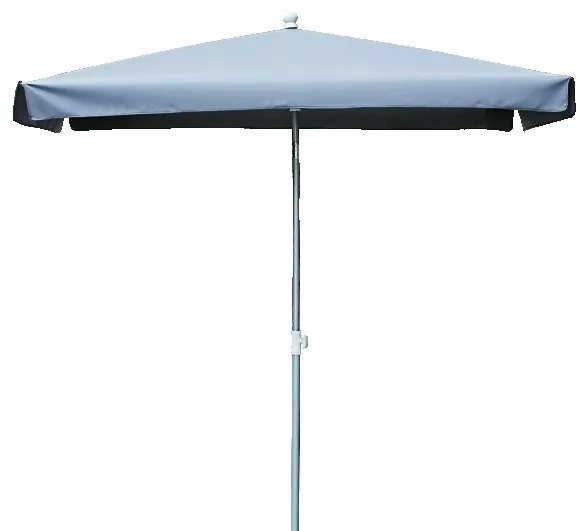
Nine fields every comparable quote must show
If any of these is missing from a quotation, the price on it means very little. Ask for them by name — a supplier who can answer quickly usually has a factory that builds to spec.
| Field | What to ask for | What it changes |
|---|---|---|
| 1. Canopy fabric | Material, weight in gsm, coating (PU / silver / black / UV finish) | Fabric weight and coating are among the largest single cost differences between two "identical" umbrellas |
| 2. Frame material | Aluminium, steel, fiberglass — and for steel, the wall thickness or section | Frame material sets both wind performance and corrosion life |
| 3. Rib count and section | Number of ribs; profile and wall thickness | More ribs and thicker sections cost more and survive more |
| 4. Canopy size — measured how | Diameter across the full open canopy, or arc for golf styles | Nominally equal sizes are sometimes measured differently between suppliers |
| 5. Printing | Method, number of colours, number of positions, panel locations | Screen print, transfer and digital differ in cost, colour range and durability |
| 6. Pole and mechanism | Pole material and diameter; push-up, crank, tilt; auto-open for folders | Mechanism grade is a hidden cost that shows up as failures a season later |
| 7. Packing | Individual sleeve, box, carton count; any retail packaging | Packing can move landed cost more than the umbrella itself on bulky items |
| 8. What is included | Base included or not; spare ribs; carry bag | "Umbrella only" quotes look cheaper next to quotes that include a base |
| 9. Terms | Incoterm, MOQ per colour or per size, lead time, quotation validity | FOB and EXW quotes are not the same price; MOQ shapes your unit price |
Where a cheap quote usually saves the money
None of these are automatically wrong — a promotional giveaway and a hotel terrace have different standards. But if a quote is 30% below the others, the saving is usually in one of these places.
Fabric weight and coating
The most common lever. A lighter canopy or a thinner PU coating looks identical in a photo and behaves differently in its second season. Ask for the gsm figure — not "same as sample", the number.
Rib section and wall thickness
Thinner walls cost less per metre and bend in the first real gust. This is invisible on a quotation and visible on the terrace after a storm.
Print positions and colours
"Logo printed" can mean one position in one colour, or three positions in four. Compare the count, not the line item.
Mechanism grade
Light-duty cranks and springs are cheaper and fail under daily commercial use. Ask what cycle testing the mechanism has passed.
Packing downgrade
Bulk polybag instead of individual boxes saves real money per unit — and shows up as damaged goods and unhappy end customers.
Terms and MOQ
Check whether the low price is FOB or EXW, and whether it holds at your quantity or only at a much larger one.
Lay the quotes side by side
An illustrative comparison — three quotes for a "2.7 m printed patio umbrella" — showing how the differences distribute. The figures below are examples of the pattern, not quotations.
| Field | Quote A | Quote B | Quote C |
|---|---|---|---|
| Unit price (300 pcs) | Lowest | Mid | Highest |
| Fabric | Polyester, weight not stated | Polyester 180 gsm, PU coated | Polyester 220 gsm, PU + UV finish |
| Frame | Aluminium, section not stated | Aluminium 8-rib, stated section | Aluminium 8-rib, reinforced section |
| Printing | "Logo included" | 1 position, 1 colour, screen print | 1 position, 2 colours, screen print |
| Packing | Bulk carton | Individual sleeve + carton | Individual box + master carton |
| Base included | No | No | Optional, priced separately |
| Terms | EXW | FOB Ningbo | FOB Ningbo |
| Landed comparison | Cheapest at the factory gate — but you pay freight, and the spec is unknown | Mid price, fully specified, delivered to your port | Highest price, heaviest spec, retail-ready |
Illustrative example of a comparison pattern — not actual quotations. The point is the method: fill every field for every quote, then compare rows, not totals.
Compare quotes on the cost of the goods at your door, not the factory gate: unit price plus freight, insurance, duty and the cost of the failures you are more likely to get from the lighter spec. A mid-priced fully specified umbrella often beats a cheap one over three seasons.
Six questions that test a quotation
1. "What is the fabric weight and coating?"
A number, or a deflection. The answer tells you whether the factory builds to spec or to price.
2. "Is the canopy size measured across the full open canopy?"
Confirms both suppliers are measuring the same way before you compare unit prices.
3. "What cycle testing has the mechanism passed?"
Real numbers (hundreds of open-close cycles) beat "high quality" every time.
4. "Can you send the spec sheet with the quotation?"
A factory-backed supplier has one already. A middleman without a factory relationship often does not.
5. "What changes if we order half this quantity?"
Tests whether the quoted price holds at your real volume — and whether the MOQ is honest.
6. "What does this price include at the port?"
Turns a unit price into a landed cost and exposes hidden freight and documentation assumptions.
Have quotes you cannot compare?
Send them over — redacted if you prefer. We will read them line by line against the checklist above, tell you where the differences sit and which spec each price actually buys, with no obligation.
Send your quotations