
Beach umbrellas for resorts and beach clubs: what to specify before the season
A beach umbrella works harder than any other umbrella in the trade: sand, salt, UV, gusts off the water, and staff opening and closing it every single day. This guide covers what changes on a beach, what it costs to operate, and the specification that survives the environment.
Four things a beach does to an umbrella
Sand
Abrasive in every mechanism it reaches: tilt joints, cranks, pole sleeves. Grit that works into a crank mechanism grinds it from the inside. Sealed or shielded mechanisms and simple mechanisms both outlast complex exposed ones on a beach.
Salt air
Corrodes steel frames and hardware far from the coast's visual cue — the damage is internal and invisible until a joint fails. Coastal sites need corrosion-resistant frame coatings and stainless fixings from the start, not as an upgrade.
UV, all day, every day
Beach umbrellas live in full sun for their entire service life. Piece-dyed fabrics fade; solution-dyed fibre holds colour through seasons. The price difference is small against a canopy that looks tired after one summer.
Wind off the water
Open shoreline wind arrives without warning and hits a canopy with nothing upwind to break it. Vented canopies and tilt mechanisms are not luxuries here — they are how the umbrella survives an average afternoon.
What to specify, field by field
| Field | Beach specification | Why it matters here |
|---|---|---|
| Canopy size | 2.0–2.4 m round typical; 2.7–3.0 m where wind allows | Bigger canopies shade more and catch more wind — size to the site, not the photo |
| Fabric | Solution-dyed polyester 220+ gsm with UV finish | Colour-fastness under permanent sun; heavier weight for daily staff handling |
| Frame | Aluminium or fiberglass ribs, corrosion-resistant coating | Salt is the failure mode; coatings and stainless fixings are the answer |
| Ventilation | Vented canopy, double layer where wind is consistent | Lets gusts pass instead of inverting the umbrella |
| Tilt | Yes — follow the sun across the day | A fixed umbrella shades the wrong loungers by mid-afternoon |
| Anchoring | Sand anchor on sand; in-ground socket or weighted base on deck | No table to clamp to; the anchor is a site decision, not a product default |
| UPF claim | UPF 50+ with test documentation if you will market it | Guest-facing claims need evidence — request the test report with the quotation |
| Branding | One panel, screen print or woven label | Subtle branding reads as quality on a beach deck; full-canopy print reads as advertising |
Typical beach specifications from common resort practice — final specification should follow your site's wind exposure and deck surface.
The cost nobody budgets: daily handling
Beach umbrellas are opened at dawn and closed at dusk, every day, by staff. Over a season that is hundreds of cycles per unit — and handling time is a real payroll line.
Light versus sturdy: the handling trade-off
Every gram saved on the frame is saved again hundreds of times a season by whoever carries the umbrella. But a frame too light for the site comes back as replacements — and a replacement in August, at peak capacity, is either expensive or late.
The balance: light enough for one person to handle comfortably, specified for the wind the site actually gets. On an exposed shoreline that usually means aluminium with a proper section, not the lightest frame available.
Mechanisms that survive sand
- Simple push-up or basic crank over complex multi-position gears
- Shielded or sealed joints where the design allows
- Mechanisms quoted with cycle testing, not "smooth action"
- Rinse schedule built into the daily close-down, not left to chance
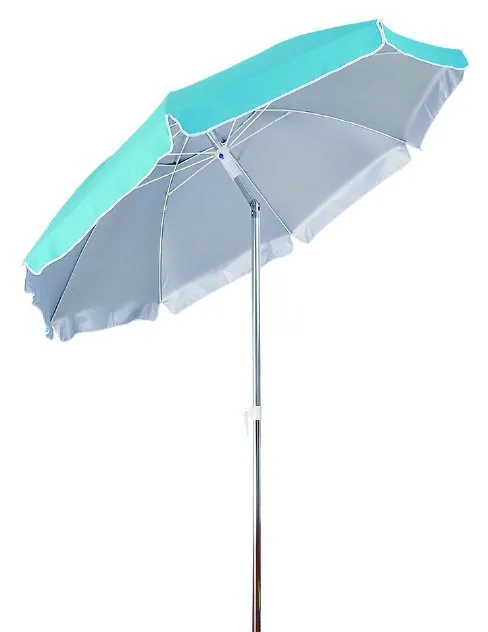
When you brief a supplier, mention who handles the umbrellas and how exposed the shoreline is. It changes the frame recommendation — and it is the kind of detail that separates a quotation from a real answer.
The buying calendar, worked backwards
Beach programmes live and die on the calendar. Cluster capacity tightens in the months before the northern-hemisphere season, and the last thing you want is a container arriving as the season ends.
| Stage | Typical duration | Notes |
|---|---|---|
| Brief, quotation and factory matching | 1–2 weeks | Longer if swatches and colour decisions are still open |
| Sample build and approval | 2–3 weeks | Custom colours and printed panels add time; include courier transit |
| Bulk production | 4–6 weeks | Peak pre-season weeks are the constraint — earlier is always cheaper in stress |
| Inspection and loading | About a week | Pre-shipment inspection and photo report before balance payment |
| Ocean freight and clearance | 3–6 weeks depending on lane | Confirm the lane with your forwarder before committing to a date |
Planning ranges, not commitments — actual dates are confirmed per order.
Have beach programmes on the water at least four to six weeks before the first guests arrive. That leaves margin for clearance, delivery, on-site assembly and one round of fixes — and it means the deck opens complete.
Equipping a beach club or pool deck?
Send the deck size, the surface, the wind exposure and your opening date. We will come back with a specification, a spares schedule and a delivery plan that lands before the season.
Specify your beach programme