
Umbrella size and specification guide
Most outdoor shading mistakes are made before a single unit is ordered: a canopy that is too small for the table, a base too light for the wind, a pole that does not fit the table hole. This page gives you the numbers to get those three right, and shows you how to turn them into a specification a factory can quote against.
The 2-foot rule: size the canopy for the chairs, not the table
The single most useful rule in the trade is simple: the canopy should extend roughly two feet beyond the edge of whatever you want shaded, on all sides.
Why matching the table size fails
Sun moves. A canopy that exactly covers the tabletop shades the table at noon and nothing else by mid-afternoon, because the low sun comes in from the side. Chairs also stick out 18–24 inches from the table edge, so the people are always outside the table's footprint.
The two-foot buffer does two jobs: it keeps seated guests in shade as the sun angle shifts, and it cuts the glare and radiant heat bouncing off the deck or paving onto the people around the table.
How to measure
- Pull the chairs out to their normal dining position.
- Measure the widest point of the whole arrangement — chairs included, not just the tabletop.
- Add about four feet total (two per side). That is your minimum canopy diameter.
- If your number falls between two standard sizes, take the larger one.
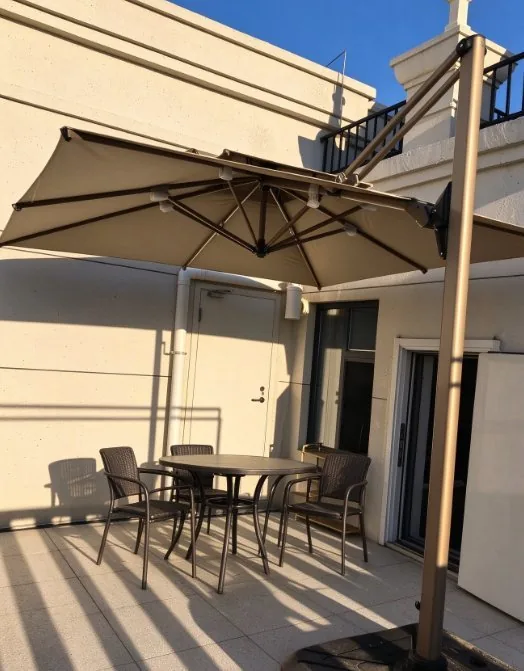
No table? Apply the same rule to the seating group you want shaded — a lounge set for four usually needs a 2.5–3 m canopy to cover the chairs plus the small table between them.
What size umbrella for what table
These are the standard pairings used across the trade. Canopy diameter is measured edge to edge across the full open canopy.
| Table or seating | Minimum canopy | Comfortable canopy | Seats shaded | Approx. shade area |
|---|---|---|---|---|
| Bistro set, 2 chairs, up to 76 cm (30 in) table | 2.0 m (6.5 ft) | 2.1–2.4 m (7–8 ft) | 2 | ~3 m² (30 sq ft) |
| 4-person round or square, 76–97 cm (30–38 in) | 2.4 m (8 ft) | 2.6 m (8.5 ft) | 4 | ~4.8 m² (52 sq ft) |
| 4–6 person dining, 97–122 cm (38–48 in) | 2.7 m (9 ft) | 3.0 m (10 ft) | 4–6 | ~6 m² (65 sq ft) |
| 6–8 person dining, 137–152 cm (54–60 in) | 3.0 m (10 ft) | 3.4 m (11 ft) | 6–8 | ~7.4 m² (80 sq ft) |
| Large rectangular, 1.8–2.4 m (6–8 ft) long | 3.4 m (11 ft) round | 2.4 × 3.0 m offset / rectangular | 6–10 | Varies by shape |
| Lounge group or sectional, no table | 3.0 m (10 ft) | 3.4 m (11 ft) or cantilever | 4–8 | ~7.4 m²+ |
Industry pairings, adapted to metric and imperial. Actual coverage depends on canopy shape, vent design and sun angle — treat these as minimums, not guarantees.
The most-specified size
The 2.7 m (9 ft) market umbrella is the workhorse of the trade. It covers the most common 4–6 person dining sets, fits most bases and containers well, and has the widest choice of fabric and frame options. If you are building a range rather than a one-off, start here.
Rectangular tables
A round canopy over a long rectangular table always leaves the two ends exposed. Either step up to an 11 ft round canopy, or specify a rectangular canopy or two smaller umbrellas over one table. Offset (cantilever) umbrellas cover the same table with less vertical intrusion.
Center pole or cantilever: which fits the space
Both shade the same diameter. They use it differently, and the choice is usually decided by the room you have.
| Center pole (market) | Offset (cantilever) | |
|---|---|---|
| Usable shade | Pole passes through the middle of the table or seating group | Pole sits at the side — the whole canopy covers usable space, roughly 20% more effective for the same diameter |
| Furniture layout | Table must have a central hole, or umbrella stands alone | Canopy hovers over tables with no hole, spas, fire pits |
| Following the sun | Move the furniture or accept the shadow drift | 360° rotation on most models — swing the shade from table to loungers |
| Low sun angles | Limited tilt; shade drifts far from the table late in the day | Tilts further to block low western sun |
| Stability | Load goes straight down into the base — lighter bases possible | Lever arm loads the base — needs a heavier base for the same canopy size |
| Space needed | Compact footprint; easy to close and store | More overhead room for the arm; heavier to move |
| Typical use | Restaurant dining sets, hotel terraces, retail | Pools, spas, gardens where furniture is arranged around the umbrella |
Cantilever umbrellas look like the premium answer to everything, but the offset arm multiplies the leverage on the base. A 3 m cantilever in an exposed position needs a substantially heavier base than a 3 m center-pole umbrella. Specify the two together, never separately.
Height, pole diameter and the table hole
Three measurements decide whether an umbrella is comfortable in a space — and all three are cheap to specify, expensive to discover after delivery.
Canopy clearance
On a table umbrella, the lowest point of the canopy should sit around 2.1–2.3 m (7–7.5 ft) above the ground when fully open — high enough to walk under, low enough that the shade falls where people sit. Tell us your ceiling, pergola or balcony if clearance is tight.
Pole diameter
Table holes are commonly 38–50 mm (1.5–2 in). Poles run slightly under that. A pole that is too thin rattles; a reducer ring fixes it. Send us the hole diameter with your enquiry and we will match the pole.
Opening clearance
Check the canopy can open fully without hitting the wall, railing or neighbouring umbrella. Crank and tilt mechanisms need a little more room than a simple push-up. On balconies this is the measurement people forget.
Choosing the arc size
Golf umbrellas are sized by arc — the curve across the canopy, which is wider than the straight span between rib tips. The arc is the number in the product name.
| Arc size | Straight span | Covers | Typical use |
|---|---|---|---|
| 60 in (152 cm) | ~53 in | One person plus bag, or two seated closely | Corporate gifts, retail, everyday use |
| 68 in (173 cm) | ~60 in | Two people, or one person with golf bag and trolley | Golf clubs, events, tournament sponsor umbrellas |
| 72 in (183 cm) | ~63 in | Two people comfortably, or spectator seating | Spectator and hospitality umbrellas at events |
Arc and span figures are typical of the market, not a specification of any single factory.
Double canopy vs single
A double-layer canopy with vents lets wind pass through instead of catching it like a sail. On an exposed golf course or a windswept terrace, the frame outlasts the single-canopy version by seasons. It costs a little more and weighs a little more — worth it where wind is the failure mode.
What the frame decides
Fiberglass ribs flex and recover; steel ribs hold shape but can take a set; aluminium is light and corrosion-resistant. Wind performance comes from material plus the joint construction, not rib count alone — ask for the material and the rib count together.
Full golf umbrella specifications, materials and printing options →
Wind exposure and base weight
An umbrella is a sail. Every canopy size has a base weight that keeps it standing, and the number depends on exposure, not on the product.
Base weight guide (center pole, table mount)
| Canopy | Sheltered patio | Open terrace | Exposed / coastal |
|---|---|---|---|
| 2.0 m (6.5 ft) | 20 kg (45 lb) | 25 kg (55 lb) | 35 kg (75 lb) |
| 2.4 m (8 ft) | 23 kg (50 lb) | 34 kg (75 lb) | 45 kg (100 lb) |
| 2.7 m (9 ft) | 27 kg (60 lb) | 45 kg (100 lb) | 57 kg (125 lb) |
| 3.0 m (10 ft) | 34 kg (75 lb) | 57 kg (125 lb) | 68 kg (150 lb) or anchor |
Starting points from common trade practice, not engineering certification. Exposed and coastal sites need site-specific assessment — and often an in-ground socket instead of a movable base.
How to read your site
- Sheltered — walls on two or more sides, low-rise surroundings: the lighter end of the range works.
- Open — rooftop terraces, beachfront, open fields: step up two weight classes.
- Coastal — salt air corrodes frames and hardware; specify corrosion-resistant coatings and stainless fixings from the start.
- Seasonal — if umbrellas come down in winter storms anyway, weight can drop to the sheltered column.
A tipping umbrella in wind damages the umbrella, the furniture and sometimes people. Bases are the wrong place to save money — the cost difference is small against a single incident.
Turning all of this into an enquiry a factory can quote
With the numbers above, a complete specification is a short list. The more of these you send, the more comparable the quotes you get back.
The specification list
- Canopy diameter or arc, and shape (round, square, rectangular)
- Structure: center pole or cantilever; opening mechanism (push-up, crank, tilt)
- Frame material and rib count; vented canopy yes/no
- Fabric: type, weight, coating (PU / silver / black / UV finish), colour reference
- Pole diameter and canopy clearance required
- Base type and weight class for your exposure
- Logo: placement, method, colours (Pantone if possible)
- Packing: individual sleeves, master carton, retail box
- Quantity per size, destination port, required arrival date
What we do with it
- Match the specification to two or three factories in the cluster suited to that construction
- Come back with itemised quotes: unit price by quantity, packing, lead time, terms
- Flag anything in your list that fights something else — a 3 m single-canopy in an exposed site, a heavy cantilever on a light base
- Send a physical sample before you commit to bulk
Not sure about a number? Send the table dimensions, a photo of the space and the wind exposure. We will suggest the specification.
Send your specificationCanopy sizes in place
The practical way to size a canopy is from the table outwards, not from the pole. These three show the clearances people actually ask about.

Table clearance — measure the canopy edge, not the pole, against your table
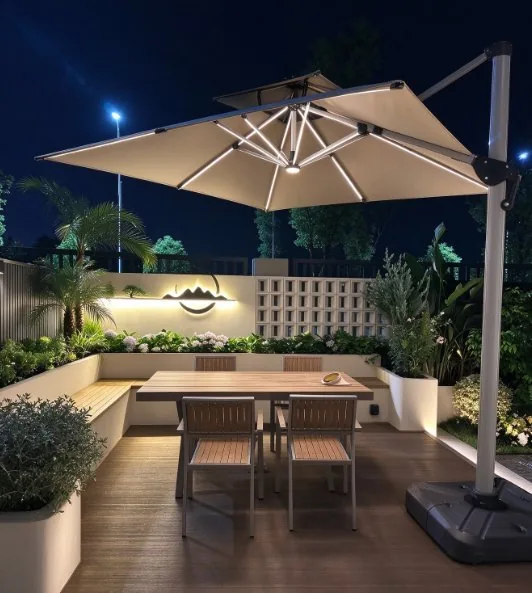
Round tables sit best under a round canopy; square canopies suit square tables

Seating for four needs roughly a 2.7 m canopy; for six, 3.0 m
Not sure which size your project needs?
Send the table or seating dimensions, a photo of the space and how exposed it is. We will come back with a suggested specification and indicative pricing.
Get a specification recommendation