
Umbrella shafts & poles
From a 8 mm telescopic shaft on a folding umbrella to a 48 mm patio pole — same product family, different machines. This cluster makes tube locally, which is why cut-to-length and special profiles are easier here than in most sourcing destinations.
Standard configurations
Three dimensions define a shaft: outside diameter, wall thickness and length. Miss the second one and the first two do not save you.
| Parameter | Common range | Notes |
|---|---|---|
| Application | Folding umbrella shaft, straight shaft, patio pole | Each uses a different diameter band |
| Outside diameter | Small shafts through to patio poles of 32 / 38 / 48 mm | Confirm the band for your model |
| Wall thickness | Confirmed per application | The most commonly omitted specification, and a common cause of bending |
| Length | Cut to length, or telescopic sections | Telescopic sets need matched section tolerances |
| Profile | Round, hexagonal, octagonal, fluted, oval | See profiles below |
| Material | Steel, aluminium, fiberglass, wood | See materials below |
| Finish | Powder coat, electroplating, electrophoresis, wood-grain transfer | Finish drives both appearance and corrosion life |
| MOQ | Confirmed per profile and finish | Custom profiles and finishes raise it |
| Lead time | Confirmed per item | Coating and slotting add time |
Typical ranges for standard production. Send a drawing or sample for an exact quote.
Why the cross-section matters
Profile is not cosmetic. It decides whether the shaft resists rotation under load, and it has to match the runner and handle you intend to fit.
Round
The most common and the cheapest. Requires the runner and handle to be rotation-tolerant or keyed another way.
Hexagonal & octagonal
Flat faces resist rotation, which is why they are used on patio poles and on shafts where the handle must not twist.
Fluted / slotted
A groove running the length of the tube keys the runner so the umbrella cannot spin open. Common on golf and patio designs.
Oval & tapered
Used where a specific look or a stepped section is required. Usually needs dedicated tooling.
Shaft, runner and handle have to agree on profile and diameter. If you are buying only the shaft, tell us what it has to fit and we will confirm the interface before production.
Material choice
| Material | Behaviour | Best for |
|---|---|---|
| Steel | Strongest per cost; needs coating to resist rust | Patio poles, standard shafts |
| Aluminium | Light, naturally corrosion resistant, less rigid than steel at equal size | Weight-sensitive models, coastal use |
| Fiberglass | Flexes and returns; non-conductive and rust-free | Golf umbrellas, exposed locations |
| Wood | Traditional appearance, heavier, needs finishing | Gift and heritage styles |
Secondary operations
Local tube making means the operations below can be done in one place, which is where the cost and lead time advantage comes from.
- Slotting — lengthwise groove to key the runner
- Drilling — holes for pins, buttons and rivets
- Tapering / reducing — stepped sections for telescopic shafts
- Bending & end forming — crook handles and closed ends
- Coating — powder coat, electrophoresis, plating, wood-grain transfer

Four things that move the price
1. Material
Aluminium costs more than steel per kilogram; fiberglass more again. Weight per piece matters, so a longer pole multiplies the difference.
2. Wall thickness
The most direct lever. It also decides whether a patio pole survives a windy season, so it is rarely the right place to save.
3. Profile and tooling
Round is cheapest. Fluted, oval or tapered sections need tooling and are quoted separately.
4. Finish
Powder coating is standard; plating and wood-grain transfer add cost and, in the case of plating, add corrosion resistance worth having near the sea.
What we check before release
| Check | What it prevents |
|---|---|
| Straightness | Umbrellas that do not hang true and runners that bind |
| Ovality of round tube | Runners that jam or handles that will not seat |
| Wall thickness at reduced sections | Poles that bend exactly where they were tapered |
| Slot and hole position | Assembly failures on your line |
| Coating adhesion and thickness | Rust and flaking in the first season |
| Telescopic fit | Sections that stick or rattle |
Shafts and poles, staged
Poles are checked and staged before packing. Finish, wall thickness and straightness are the three items worth writing into a specification.
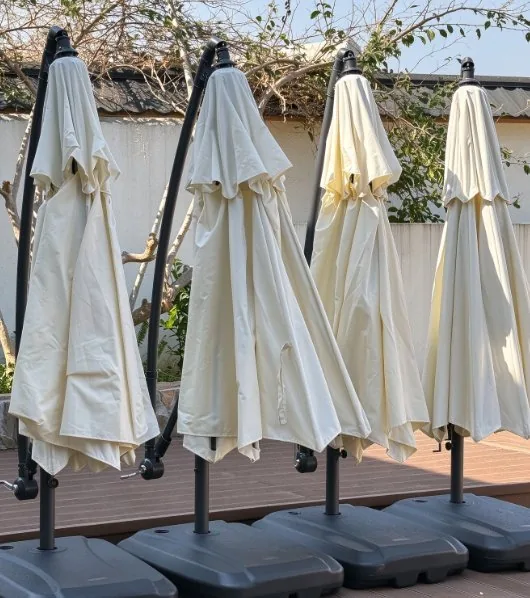
Finished poles staged before packing — finish is inspected at this point

Left closed overnight — the pole finish is what the weather reaches first
Shaft questions
Can you cut to my exact length?
Yes. Provide the length and tolerance, or send a sample. Cut-to-length is standard; very tight tolerances should be stated up front.
Do you supply telescopic shaft sets?
Yes, as matched sets. The sections have to be specified together, because the fit between them is the part that fails most often.
Can the shaft match my existing handle and runner?
Yes, if you tell us the interface. Send the handle and runner, or their drawings, and we confirm diameter, profile and slot before quoting.
What finish lasts best outdoors?
It depends on the base material and the environment. Tell us whether the product is used inland or coastal and we will recommend a finish rather than defaulting to the cheapest.
Quote a shaft or pole
Send diameter, wall thickness, length, profile and finish — or a sample — and we will quote against it.
Request a component quote