
Different buyers need different umbrellas
A promotional distributor, a hotel group and a golf club all buy "custom umbrellas" — and specify almost nothing in common. This page is organised by buyer type so you can find the conversation that matches yours, including the specifications your own clients will ask about.
What each sector actually specifies
| Buyer type | Typical specification focus | Usual quantity | Decision driver |
|---|---|---|---|
| Promotional products distributors | Print colours, event deadline, blind ship, distributor-only pricing | 300–3,000+ per programme | Client deadline and repeat programme potential |
| Outdoor brands & retailers | Fabric performance, recycled content, PFAS-free finish, packaging, spare parts | 1,000+ per SKU | Brand risk and compliance documentation |
| Hotels, resorts & restaurant groups | Commercial durability, base weight, wind rating, replaceable canopies, warranty | 50–500 per property, multi-site rollouts | Cost per season and maintenance workload |
| Golf clubs, tournaments & events | Arc size, wind performance, full-panel branding, delivery to venue | 100–2,000 | Event date reliability and brand visibility |
| Corporate gifting buyers | Presentation, gift packaging, smaller runs, personalisation | 50–500 | Presentation quality and on-time delivery |
The same factory floor serves all five. What changes is the specification, the documentation and the schedule — which is exactly where a sourcing partner earns their place.
Promotional products distributors
The most programmatic buyers in this trade: predictable, volume-driven, and ruthless about deadlines because their client's event does not move.
What your programme needs
- Work backwards from the event date — artwork approval, production, freight, customs, then your own warehouse handling. Overseas custom programmes commonly need up to 120 days from all approvals
- Colour decisions early — custom-dyed fabric carries dye-lot minimums that can dwarf the umbrella MOQ
- Artwork checked before you quote your client — we flag unprintable artwork free of charge, before it becomes your problem
- Distributor boundaries respected — we do not approach your end client; blind shipping and your paperwork are standard
- Peak season awareness — approvals in October–December face the longest queues of the year
A realistic programme shape
| Element | Typical |
|---|---|
| Minimum per programme | 600 pieces common for fully custom overseas work |
| 1–4 spot colours, Pantone matched, screen printed on canopy | |
| Packaging | Bulk cartons, or individual polybag with printed header |
| Reorder rhythm | Seasonal or per-campaign; screens often retained for repeat runs |
Programme figures reflect published practice of established overseas umbrella programmes in the promotional trade; your project may differ and we quote from your actual specification.
Outdoor brands, retailers and importers
Brand buyers carry the most compliance risk of any category, and since 2026 the questions have changed: recycled content evidence and fluorine-free finishes are now standard opening questions, not nice-to-haves.
What they ask first
- Is the recycled claim documented? — GRS scope certificate plus a transaction certificate tied to the specific order, or the claim is unverified
- Is the finish PFAS-free? — the EU PFHxA restriction took effect on 10 October 2026; C6 fluorinated DWR is out for consumer textiles
- Can you supply test reports? — hydrostatic head, UPF, colour fastness, restricted substances
- Spare parts availability — replacement canopies and runners as orderable SKUs
How we support the programme
- Specify rPET canopy options where the recycled content is documented, not asserted
- Source fluorine-free DWR finishing for EU-bound programmes and provide the paperwork trail
- Structure the spec sheet so fabric weight, coating and test values are comparable across factories
- Build the spare-parts list into the quotation from the start, so reorders do not need a new tooling discussion
Hotels, resorts, restaurants and cafés
Commercial shade is bought as an asset with a service life, not as a product. The specification is written to survive daily operation by staff who are not umbrella specialists.
The specification that holds up
- Canopy — 220+ GSM polyester or pongee, 1,500+ mm hydrostatic head, UPF 50+ where a sun claim is intended
- Frame — 8 ribs minimum for 2.5–3 m umbrellas, 10 preferred; aluminum or 1.2 mm+ powder-coated steel pole; stainless or brass hardware
- Venting — double-tier vented canopy as standard for open courtyards, rooftops and poolside
- Ribs — fiberglass flexes and recovers in gusts where steel bends permanently; the practical choice for coastal sites
- Drainage — holes at rib tips prevent water pooling that rots stitching from the inside
- Hardware — marine-grade stainless fasteners; mild steel screws seize within a season or two
The commercial numbers
- Base ballast — a 2.5 m unit needs roughly 25 kg sheltered, more when exposed; a 9 ft market umbrella on an open sidewalk needs 150 lb or a bolt-down plate
- Service life — frames 3–5 seasons with maintenance; polyester canopies 2–3 seasons; solution-dyed acrylic roughly doubles fabric life
- Spare parts as SKUs — replacement canopy, runner and ribs orderable for at least two seasons after purchase
- Fire codes — US hospitality buyers often reference NFPA 701 for canopies; confirm at quotation stage if it applies to you
A unit replaced every season costs more over five years than one that lasts three — before counting the labour and the guest complaint. We quote against service life, and we say so when a cheaper build is a false economy for your use case.

Poolside — large canopies, fixed bases, daily handling by staff

Evening service — a lit canopy extends terrace revenue past sunset
Golf clubs, tournaments and events
Two requirements dominate: wind behaviour on an exposed course, and a brand visible across a green. Both are specification questions, not marketing ones.
What gets specified
- Arc size — 60, 68 or 72 inch, chosen against the golfer and the caddie, not the catalogue photo
- Rib material and count — fiberglass frames flex in gusts; this is the difference between a recovered umbrella and a written-off one
- Double canopy with venting — releases pressure instead of catching it
- Full-panel branding — sublimation handles gradients and multi-colour crests that screen printing cannot
- Delivery timing — event stock must land with days of buffer, not hours
Programme considerations
- Pro-shop retail programmes need hangtags, barcodes and retail-ready packing from the first order
- Corporate hospitality days often need two or more brand variants in one production run — plan screens together, not separately
- Member giveaways repeat annually; the second year should cost less and take less time than the first
- Bulk storage between seasons is your decision, not ours — but we will tell you honestly whether warehousing in China is worth it for your volume
Corporate gifting and brand teams
Smaller quantities, higher presentation expectations, and a hard deadline set by an event calendar rather than a season.
What matters here
- Presentation — gift box, sleeve, ribbon, tissue. The unboxing is part of the product at this price point
- Photo or video sample approval — for urgent programmes, a documented video of the finished item can replace shipping a physical sample
- Personalisation — per-unit names or titles are possible on some models at quantity
- Deadline discipline — tell us the in-hand date first; we will tell you which options survive it
Realistic expectations
Corporate gifting quantities sit below promotional programme minimums, so pricing per unit is higher and stock models with custom printing are usually the sensible route rather than full custom development.
If your quantity is below roughly 200 units, we will say so and propose a stock-plus-print programme rather than pretend a custom build is affordable. That conversation is short, honest, and usually ends in an order both sides are happy with.
Where these end up
Three end settings for the same product category. Each one pulls the specification in a different direction.
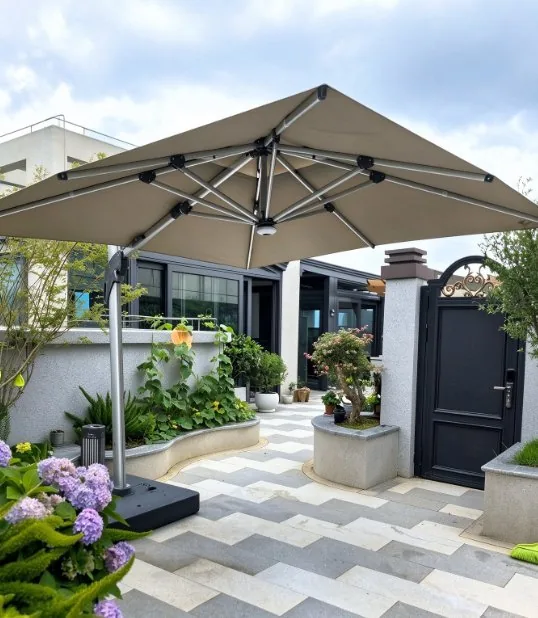
Landscape and garden retail — orders follow the season, not the calendar
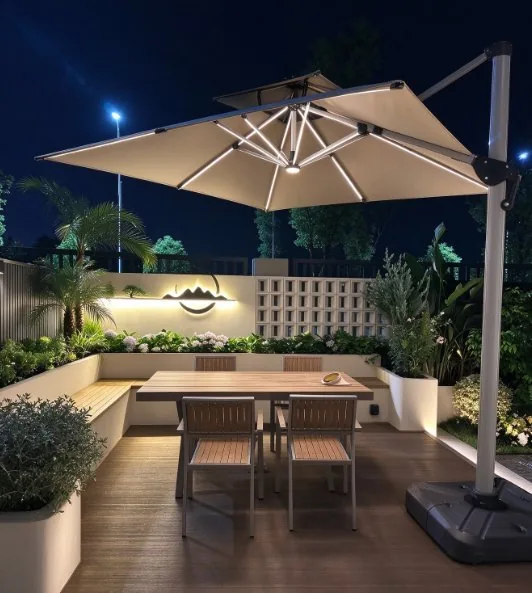
Hospitality terraces — evening use drives lighting and valance add-ons
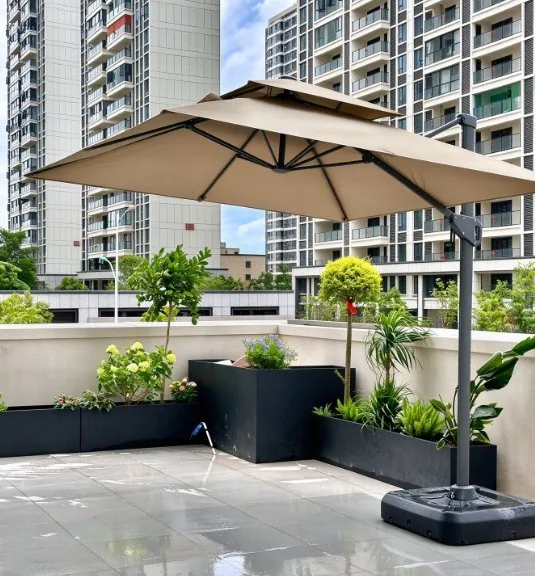
Balcony and rooftop retail — smaller canopies, heavier bases
Your sector is not listed?
Tell us what you buy and who you sell to. If it involves shade, fabric, frames or components from this cluster, we can probably help — and we will say so plainly if we cannot.